On this page
The kick and snare sound sharp when you listen to the drum tracks by themselves. But once the guitars join in and the drummer starts a blast beat, the whole kit can turn into a nonstop rush of cymbals, making it hard to pick out individual hits. This isn't always the drummer's fault or an issue with the drum samples.
At high tempos, rapid-fire hits, long drum tails and cymbal wash all compete for space. Add thick guitars, and it gets even harder to tell where one hit stops and the next starts.
You don't have to make every blast beat sound perfectly clean or mechanical. In raw black metal, that wall of sound can be part of the style, while technical death metal might need the kick and snare to stay clear and separate. Before you start changing the drums, think about which parts you want the listener to follow.
Why Blast Beats Can Turn Into a Blur
A rapid-fire passage creates a different mixing challenge from a single heavy snare hit. You can make one hit sound huge by giving it a long tail and lots of space, but when the drummer speeds up, that same sound can cover the next few hits.
Repeated Hits Leave Less Space for Each Attack
When the space between hits shrinks, the decay from one drum can overlap with the next attack. Low-frequency kick sustain, snare ring, room ambience and reverb can all add up. The drum bus might get louder but less clear because sustained sound fills the gaps that would normally help you distinguish the hits.
Making the sound shorter doesn't always make it better. If the snare loses all its body, it can turn into a series of thin ticks instead of sounding like a real drummer. Keep enough decay to preserve the drum's character, and listen at the song's actual tempo instead of checking only a few isolated hits.
Cymbal Wash Can Hide the Rhythm of the Shells
Blast beats often come with constant cymbal playing. Open hi-hats, rides and crashes can create a steady layer that competes with the snare's attack, especially when bright guitars come in. Turning up the snare fader might help, but it can also make the close-mic snare stick out too much from the rest of the kit.
How you balance cymbals and shells is a production choice, not a strict rule for mixing metal. In their 2025 study *"Mixed" Results: An Introduction to Analyzing Music Production through Eight Commissioned Metal Mixes*, Jan-Peter Herbst and Eric Smialek compare eight versions of the same song, *In Solitude*. The kick and snare separate differently during its blast beat, changing how the passage feels even though the performance is the same.
Find Out Which Part of the Beat Is Disappearing
Loop the transition from a slower section into the blast beat, and keep the full mix playing. Lower one group at a time, then bring it back to its original level. This helps you figure out whether the problem lies in the drum sound, the other instruments or the way the drum tracks interact.
| What You Hear | First Test | What to Investigate |
|---|---|---|
| Snare vanishes under the ride or crashes | Briefly lower the overheads or cymbal spot mics | Cymbal level, sustained wash, overhead processing |
| Kick beater or snare attack disappears when rhythm guitars enter | Briefly lower the rhythm guitar bus | Guitar-to-drum balance, masking around the drum attacks, guitar fizz and cymbal overlap |
| Kick becomes a low rumble instead of separate hits | Listen to kick and bass together, then briefly lower one | Kick decay, bass overlap, attack-to-body balance |
| Snare sounds thin when overheads are added | Compare close and overhead mics in mono | Polarity, timing and combined frequency response |
| Some rapid hits disappear, but others remain | Inspect the unprocessed close-mic track | Performance variation, gate settings, missed triggers |
| Drum bus sounds loud but loses its accents | Bypass bus compression at matched loudness | Attack, release, gain reduction and cymbal pumping |
Lowering or muting something briefly is a diagnostic test, not a final mix decision. If the snare comes back when you lower the overheads, you still need to decide whether those mics should be quieter, less bright or less processed. The best choice depends on what those mics contribute to the kit.
Quick listening test: Play the same blast beat with just the drums, then with drums and bass, and finally with the whole band. Keep the monitoring level consistent. The point where the hits start to blur tells you more about the conflict than another EQ sweep with the drums soloed.
Keep the Snare Audible Without Turning It Into a Tick
A snare that sounds bright on its own can still get lost in a blast beat, especially if most of its sound comes from a quick, sharp attack. Adding more treble isn't always the fix. The drum's body and the contrast between hits also help make its rhythm clear.
Balance Snare Body and Attack at Full Speed
Bring the snare close mic into the full drum mix and listen through an entire blast section. Can you hear the accents, or does the snare blend into one continuous sound? If there's enough body but not enough definition, try a small tonal or transient adjustment. If the snare already has a sharp crack but still sounds small, adding more attack might only make it brittle without fixing the problem.
Snare tuning, heads and damping matter before any processor is inserted. Mark Mynett's research on drum sound at source describes how tuning and head interaction shape attack and sustain. If you're still recording, aim for the right balance of ring and control at the drum itself instead of relying on aggressive processing later.
Check the Mics Before Adding Another Processor
A close snare mic, a bottom mic and the overheads all capture different versions of the same hit. Their polarity and timing relationships affect the combined sound. If the snare loses body when you add another mic, check the blend before boosting low mids everywhere. Flipping polarity can help, but it's not always the answer. Listen to the whole kit and check whether a timing adjustment improves the result.
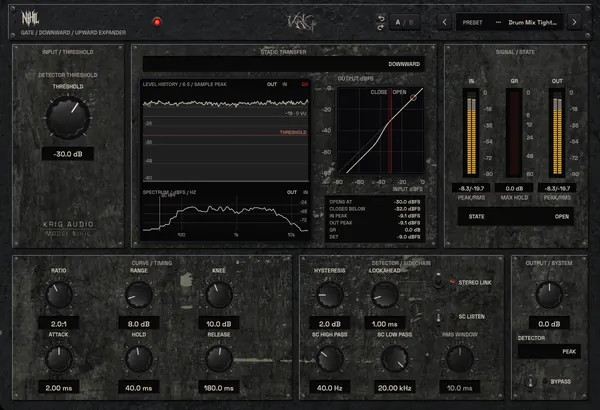
Bleed control needs attention too. A gate that works well between slower snare hits might stay open during a rapid-fire blast, or it might miss quieter hits if the drummer plays with less force. Sometimes a gentler downward expander can reduce spill without the obvious on-off effect of a hard gate.
If the detector can't find clean gaps, manually lowering clip gain *between* hits may help. Neither approach can remove cymbal wash that overlaps the snare attack itself. Specialized spectral de-bleeding or drum source separation may reduce some simultaneous spill, but listen for damaged transients, artifacts and changes to the multi-mic balance before keeping the result.
Gate check: Listen for the quietest snare hits you want to keep, with the rest of the kit playing. If the processor misses those notes, cuts the ring too short or chatters because of cymbal bleed, don't keep raising the threshold. Try adjusting detector filtering, attack, hold and release, or consider leaving the track without a gate.
Make Double-Kick Patterns Clear Without Losing Their Weight
Rapid-fire double-kick patterns can lose clarity when the low-frequency sustain lasts too long relative to the time between hits. A kick with a deep, lingering tail can sound massive on its own, but during a sustained run those tails can merge into a continuous low end.
Work on Decay Before Adding More Click
Listen to the kick during the fastest section as well as the easier parts. If the hits start to blur, try a tighter sample, a different mic blend, better damping at the source or more controlled sustain in the mix. Don't shorten the kick until every hit sounds like a separate tap. The low end still needs to support the riff.
Turning up the beater attack can help the rhythm stand out, but too much can make the kick sound like a plastic typewriter. The right amount of attack depends on the guitars, the drummer's technique and the production style. A raw black metal track and a modern technical death metal mix might handle this very differently.
Check the Kick Against the Bass, Not in Isolation
The bass guitar can cover up the kick's body, especially during rapid low notes. The kick can also dominate so much low end that the bass stops carrying the riff. Start by listening to both together and adjusting their levels before making large EQ changes.
If a certain frequency range consistently overlaps, a small cut on one instrument might solve it. If the conflict changes with the song, automation can work better than a permanent EQ cut. Neither the kick nor the bass needs to own one frequency range all the time. Their roles depend on tuning, drum sound and the notes being played.
When individual kick hits disappear behind sustained bass notes, a kick-triggered dynamic EQ or multiband compressor on the bass can create room only during those hits, provided the DAW and processor support an external sidechain. At blast-beat speeds, check that the reduction recovers naturally and doesn't turn the bass into a rapid pulse. A more complex spectral ducking tool is another option, not an automatic improvement over a small level or EQ change.
Keep the Cymbals From Taking Over the Drum Bus
Cymbals often give a blast beat its drive and aggression. Remove all their wash and the part can feel smaller, but let the wash take over and you may lose the distinction between kick, snare and ride patterns.
Try these checks in order, stopping when the balance works:
- Lower the overheads or cymbal spot mics briefly. If the shells become easier to hear, bring those mics back up until the kit feels spacious but still clear.
- Listen for harsh or sustained frequency areas. A targeted EQ move may help, but don't filter away the body of the whole kit simply because the overheads contain cymbals.
- Check room and parallel channels. Heavy compression can bring up cymbal sustain and bleed between drum hits, even if the dry overheads sound fine.
- Compare blast beats with the slower passages. Automation can let the cymbals sound bigger during half-time sections without overwhelming the rapid-fire parts.
Be Careful With Drum-Bus Compression
A compressor can help the kit feel more connected, but at blast-beat tempos it might still be recovering from one hit when the next arrives. That can reduce the contrast between attacks and sustain. Depending on the settings, kick and snare hits may also cause the cymbals and room mics to change in level.
Before adding more compression, compare the drum bus with and without processing at matched loudness. If the uncompressed drums have clearer accents, try less gain reduction, different attack and release settings, or separate processing for shells and cymbals. If repeated double-kick hits are driving the detector too hard, a sidechain high-pass filter can reduce that low-end influence without filtering the kick out of the audio path.
Parallel compression can add body to the close mics without making the overheads surge with every kick and snare, but the parallel path still needs careful balancing and alignment. Gentle soft clipping on a shell bus can also catch occasional peaks without a compressor's release envelope (more on that in clipper or limiter). It changes the waveform and adds distortion, though, so compare at matched loudness and check whether the snare attack and kick low end still sound right.
Samples and Editing Can Help, but They Change the Feel
Using samples is common in modern metal because they can add a more consistent attack or body when the recording lacks it. But that doesn't mean you should always replace the original sound. A sample is helpful when it fixes a specific problem without covering up what the drummer played.
Check Every Trigger at the Fastest Passage
Rapid-fire hits can reveal detection mistakes that you might miss in slower parts. A weak kick might fail to trigger, a strong hit could double-trigger, or a sample's tail might overlap the next note. Zoom in if needed, but always listen to the whole phrase instead of fixing waveforms without checking how they sound.
When you blend samples with an acoustic recording, check how the sample aligns with the original hit and how their polarities interact. If the two signals combine poorly, you can lose punch or low end even after adding another layer. Programmed drums can run into a similar problem when the same long sample plays on every hit with little variation.
Consistency Isn't the Same as Impact
A drummer won't hit every note with the same force. Accents shape the blast beat, and small variations can make rapid-fire sections feel played rather than assembled. Replace those details with identical samples and velocities, and you may get a loud string of hits with little musical phrasing.
Some styles use that mechanical precision on purpose, and it can sound intense. But it's a mistake to treat it as the only professional approach. The same eight-mix study of metal production shows how different balances between individual drum sounds and the overall blend can produce very different impressions of the same blast beat.
Check the Fastest Part, Then Listen to the Whole Song
Once the blast sounds clearer, return to the slower grooves, fills and exposed drum sections. A snare sample that helps at full speed may dominate a half-time beat. A very short kick that makes double-bass patterns readable may feel weak when the drummer leaves space between hits.
For your final check, listen to the music as well as the meters:
- At the original tempo: Can you follow the kick and snare accents without concentrating on individual hits?
- At matched loudness: Does the processed kit have more definition, or does it only sound louder and brighter?
- With the full band: Do the drums still carry the rhythm when guitars, bass and vocals return?
- In mono and at a lower listening level: Are the main accents still audible, or were they relying on stereo width and volume?
- Across transitions: Does the drum sound suit both the blast and the slower passages, or would a small automation move help?
A blast beat doesn't need to sound perfect. Sometimes the rush of cymbals and drums creates the right mood for the song, and separating every hit can make it feel too clean. But if you want listeners to hear the kick and snare driving the riff, that clarity needs to survive the full mix. The best fix brings back the rhythm without losing the feel of the performance.
Image credits
- Drum set with cymbals and microphones in a music studio: Shixart1985, CC BY 2.0, Wikimedia Commons. Cropped and resized by KRIG Audio.
Questions on this topic
Repeated kick and snare hits leave little time for each attack to stand apart, while cymbal sustain and dense guitars can mask their definition. Start with the full mix playing, then lower the overheads and guitars separately. If the hits become easier to follow, work on that balance before adding more drum EQ or compression.
Listen for both the snare's attack and its body. Check the balance between close mics and overheads, as well as polarity and timing where multiple mics capture the same hit. If the snare is already sharp but lacks weight, another high-frequency boost may make it harsher without helping. Compare every change at the actual blast tempo and within the full arrangement.
Gating or downward expansion can reduce bleed between hits, but only if the detector can distinguish the drum from the spill. At high speeds, unsuitable timing can miss softer hits or chop the decay. Try detector filtering and adjust attack, hold and release before raising the threshold. Manual clip-gain editing can reduce spill *between* hits, but neither that editing nor a conventional gate can separate cymbal bleed from a snare hit when both happen at once.
They can improve consistency or reinforce a weak attack, but they can also make rapid hits sound identical. Check triggering accuracy, missed and double detections, sample duration, velocity variation and the alignment of the sample with the recorded drum. The right choice depends on whether the production needs natural variation or a deliberately precise, processed character.
There is no reliable setting based on tempo alone. Listen to what happens during a sustained blast: if the drum bus hasn't recovered before the next hit, attacks may lose definition and the cymbals or room may surge. Try less gain reduction, different attack and release settings, or separate shell processing. A sidechain high-pass filter may stop deep kick energy from driving too much gain reduction. Judge everything at matched loudness in the full mix.